Video Poker by Pokerist
- 4.4
- Rating
- 1.00M
- Installs
- Free
- Price

 Analysis by App-foxy
I spent time with Video Poker by Pokerist as a phone-first card game, and my first impression was that it understands why video poker works on a small screen. A hand is quick to read, the decision arrives immediately, and I can play without setting aside a long block of time. It is a game for short bursts rather than a story-driven card adventure, so its appeal depends on whether I enjoy making repeated decisions around poker hands and managing the rhythm of play.
The game is developed by KamaGames and is free to install. It has built a sizable audience, with more than a million installs and an average rating of 4.5 from roughly 75 thousand ratings. Those figures suggest that the basic format connects with many players, but they do not remove the need to look closely at the way the game handles variety, progress, spending, and long-term motivation.
How Video Poker turns simple hands into a longer play loop
I look at this game’s longer play loop as a shift from simply learning the hand to choosing how I want each session to feel. Sticking with one variation helps me notice patterns, while trying another can reset the puzzle without requiring a new kind of control. That choice becomes especially useful when several people share a device, because a little coordination can keep casual turns from becoming an open-ended session.
You May Also Like

 Blood Strike: 2.5 Anniversary
Blood Strike’s Loadouts Turn Every Drop Into a Tactical Gamble
A close look at Blood Strike’s custom loadouts: how fast access to signature weapons reshapes its battle royale rhythm, rewards preparation, and narrows the gap between fights.

 Pandora - Music & Podcasts
Pandora’s Music Is Easy to Start, but Harder to Recover
Pandora’s strength is its low-effort path from a seed to a station. Its weak spot is how much confidence it asks you to place in connection, setup, and quiet recovery.

 8 Ball Pool
 Is Built on Rivalries, Rematches, and Routine
A close look at the rivalries, rematches, shared routines, and unanswered safety questions that turn a quick pool match into a persistent mobile community.

 Samsung Music
’s Quiet Strength Is Playing What You Already Own
Its reach comes less from spectacle than from dependable access to a personal library. That simplicity is both the app’s strongest retention engine and its ceiling.

 AccuWeather: Weather Radar
AccuWeather Review: A Quick, Clear Forecast for Everyday Decisions
For everyday plans, the best forecast is the one you can understand quickly. AccuWeather makes rain timing, radar, and local conditions easy to act on, with a few trade-offs.

 Hill Climb Racing
Why Hill Climb Racing Still Turns Crashes Into One More Run
A tiny car, a bumpy hill and one more upgrade: Hill Climb Racing keeps resurfacing because its simple chaos makes every near-miss feel personal.
More From Our News Desk



The first goals are easy to understand
The opening appeal is straightforward: choose a video poker table, receive a hand, decide which cards to keep, and let the draw complete the result. I like that the central goal does not need a tutorial full of rules before it becomes meaningful. If you already know poker rankings, you can begin making choices almost at once. If you do not, the format is still approachable because each round presents a compact problem instead of a large board filled with unfamiliar controls.
That simplicity gives the early game a useful sense of direction. I am not trying to move a character through a map or learn a complicated deck-building system. I am trying to improve the quality of each hold decision and see whether the next draw completes a stronger hand. The immediate target is therefore personal and practical: understand the machine, recognize the hand, and avoid throwing away useful cards.
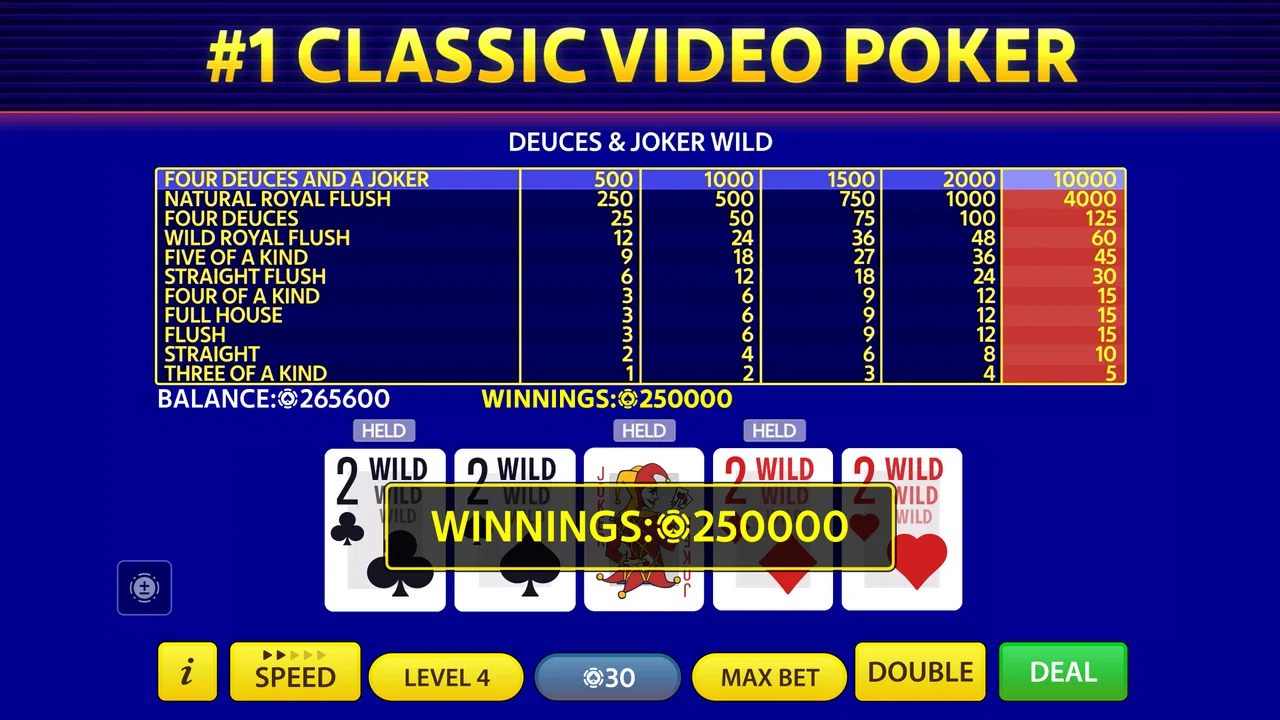
The variety matters here. The game presents more than 40 variations, so the early experience is not limited to one fixed version of video poker. That breadth can be exciting for a player who enjoys comparing rule sets and hand patterns. It also creates a small learning challenge: a choice that feels sensible in one variation may not be the best choice in another. I recommend resisting the temptation to jump between tables too quickly. Learning one format first makes the differences between later options easier to appreciate.
One useful habit is to treat the first sessions as practice in reading the pay structure rather than as a race to find the most exciting table. Before committing to a variation, I look at what hands matter and how the game presents the possible outcomes. This slows the pace slightly, but it prevents a common mistake: assuming that every video poker table rewards the same decisions. The game is more enjoyable when I approach each variation as its own small puzzle.
Progress feels more like growing familiarity than a grand campaign
Video Poker does not need a conventional adventure plot to create momentum. Its progress signals come from the hands I begin to recognize, the variations I become comfortable with, and the growing confidence behind each hold or discard decision. That kind of progress is subtle, but it suits the genre. I can feel improvement even when the result of a particular hand is unlucky, because the decision itself may still have been sound.
This is also where the large selection of variations can work both ways. For a curious player, discovering a new format refreshes the routine. For someone who wants a single, clearly staged campaign, the experience may feel less directed. There is no obvious narrative destination pulling me forward; the motivation comes from mastering the loop and deciding how much variety I want.
I found that setting small personal goals helps. I might spend a session focusing on identifying strong starting pairs, then another session comparing how a promising draw behaves in a different variation. These are not formal objectives I am claiming the game provides; they are ways I create structure around its repeated hands. Without that structure, the game can become a sequence of similar rounds that blur together.
The strongest progress signal is better decision-making, not simply a longer session. That distinction is important. A player who enjoys card probability and pattern recognition can find plenty to work toward, while a player who needs constant unlock notifications, story chapters, or visible character upgrades may find the progression less satisfying.
The difficulty curve comes from judgement, not complicated controls
The controls are not the demanding part. The challenge comes from deciding what to preserve when the hand is incomplete. A pair, a possible straight, a flush opportunity, or a high card can each invite a different decision, and the correct choice depends on the variation being played. That makes the difficulty curve feel gradual in a natural way: the rules remain readable, but the quality of the decisions can improve over time.
At the beginning, I can rely on familiar poker instincts. Later, those instincts need refinement. Holding too many cards because they look individually attractive can weaken the overall draw. Chasing a rare result can also make a session feel more volatile than expected. The game rewards patience with the decision process, even though the outcome of each draw remains outside my control.
Players who want a clearly measured challenge should know what kind of challenge this is. It is not primarily about faster reactions or increasingly aggressive opponents. It is about learning the logic of each variation and accepting that a good choice will not always produce a winning hand. That can be satisfying for analytical players, but frustrating for anyone who expects skill to guarantee a visible result.
My practical advice is to avoid judging a variation after only a few hands. A short run can feel unusually generous or unusually harsh, and that can distort your view of the format. Instead, I pay attention to whether I understand the choices being offered and whether the table gives me a reason to keep learning. This approach makes the difficulty feel fairer because I am evaluating decisions rather than treating every loss as evidence that the game is working against me.
Variety keeps the middle game alive, but it can dilute focus
The multi-hand and classic formats give the game its main source of long-term variety. Switching formats can change the way I read a hand and can prevent the experience from becoming completely repetitive. For a player who already likes video poker, having many variations in one place is a meaningful advantage over a very narrow alternative that offers only one familiar table.
At the same time, variety is not automatically progression. Opening another variation may feel fresh, but it does not necessarily give me a stronger reason to master the current one. I sometimes prefer staying with one table until its decisions become second nature. Moving too often can turn the game into browsing rather than playing, especially when I am looking for a clear sense of achievement.
The multi-hand approach is best suited to players who enjoy comparing outcomes across simultaneous decisions and who can keep track of several results without losing the thread of the session. It is less appealing if I want a calm, single-hand rhythm. In that case, the classic format is likely the better starting point because it leaves more attention for the choice in front of me.
For an everyday example, I can imagine opening the game during a coffee break, playing a few hands, and stopping without needing to remember a story objective. On a longer evening, I might choose one variation and study how my decisions change as the session continues. That flexibility is one of the game’s real strengths: it can fit both a brief pause and a more focused card-playing session, provided I am comfortable with repetition.
Where retention becomes pressure
The game is free, which makes trying it easy, but its monetization deserves attention. In-app purchases range from $0.99 to $999.99 per item. That is a very wide range, and it means I would approach the game with a firm spending boundary rather than treating optional purchases as an invisible part of normal play.
Card games built around repeated hands can encourage one-more-round behavior, particularly after a near success or a disappointing result. The quick cycle makes it easy to continue without noticing how long I have been playing. I find the best way to keep the experience comfortable is to decide in advance whether I am playing for a short break or a longer session, then stop at that point rather than using the next hand to chase a better result.
This matters especially for players who are sensitive to virtual currency loops or who prefer games with a single upfront price. Video Poker may be a poor fit if spending prompts interrupt the relaxed card-table feeling you want. It is also not the right choice for someone seeking a completely consequence-free pastime, because the combination of free access and optional purchases requires personal discipline.
I would not recommend buying anything simply because a run has gone badly. A poor result is part of the uncertainty of video poker, not a problem that can be solved by spending more. Treating purchases as optional entertainment rather than a way to recover losses is the healthier approach. If that boundary sounds difficult to maintain, a paid card game with no purchase loop may be a better alternative.
How it compares with ordinary card-game alternatives
Compared with a traditional poker app, this game is more focused on the draw decision than on reading human opponents. There is no need to wait for a table to fill or interpret another player’s betting style. That makes it more convenient for solo play, but it also removes the social tension and bluffing that many people associate with poker.
Compared with a simple offline deck of cards, it offers much more variation in presentation and format, but less freedom to invent house rules or play entirely outside a designed reward loop. A physical deck is better for teaching a group or creating your own game. This app is better when I want immediate solo access and a polished video poker structure.
Compared with a casino-style alternative that concentrates on one machine, the selection here is the more important distinction. The many variations give experienced players more room to explore. However, a single-format game can be easier to learn because there are fewer rules and fewer choices competing for attention. I would choose this title for breadth, not for the most minimal possible interface.
The Teen content rating is another practical point for households. It is not a game I would describe as a children’s card-learning tool, particularly because of its casino-style presentation and optional purchases. Parents deciding whether it belongs on a shared device should consider both the age guidance and the spending controls available on that device.
Who will enjoy it, and who should skip it
I think Video Poker is a good match for adults and older teens who already enjoy poker hands, probability, and short repeatable sessions. It is especially suitable for someone who wants to explore multiple video poker variations without carrying a physical deck or committing to a multiplayer table. The free entry point also makes it easy to test whether the format suits you before investing serious time.
I would be more hesitant to recommend it to players who need a strong story, social competition, or constant unlocks. The game’s satisfaction comes from the hand-to-hand decision and from becoming more familiar with the available formats. If that loop feels repetitive after a few sessions, additional variations may not change your opinion.
It may also be a poor choice for anyone who wants a purely educational probability tool. Although the hands encourage careful thinking, the presentation is built for play rather than formal lessons. Likewise, people who want a completely offline, purchase-free experience should look toward a simpler card app or a physical deck instead.
Practical ways to get more from each session
I recommend starting with one variation and learning its hand priorities before exploring the wider selection. This makes the game feel less like a lottery of unfamiliar tables and more like a skill-building exercise. Once the basic decisions become comfortable, switching formats becomes informative rather than confusing.
For multi-hand play, I try to make the initial hold decision deliberately and then review the results afterward instead of reacting emotionally to each individual outcome. Seeing several hands develop can tempt me to second-guess every choice. A consistent method is more useful than changing strategy after one unlucky draw.
I also keep a clear session limit. Because rounds are short, the game can fill spare moments very easily, but the same convenience can make it harder to notice when the session has stretched. A timer, a fixed number of hands, or a simple stop point after exploring one variation can preserve the casual feel.
Finally, I treat the purchase system as something to manage, not something to chase. I would set device-level spending protection before handing the phone to a younger player, and I would never use a purchase to justify continuing after I have stopped enjoying the session. These habits do not change the game’s rules, but they make its free-to-start model easier to handle responsibly.
My progression verdict
Video Poker by Pokerist sustains play through recognizable hands, a broad collection of variations, and the gradual satisfaction of making more informed decisions. Its goals are modest but clear: learn the format, improve your holds, and explore the different ways video poker can be presented. The pacing is flexible, working well for a few minutes at a time or for a longer focused session.
Its limits are just as clear. Progress is mostly self-directed, the core loop can become repetitive, and the purchase range means I would not approach it casually without a spending boundary. The game does not replace a social poker table, a story-heavy card adventure, or a completely offline deck simulation.
Still, I enjoyed it most when I treated it as a collection of compact decision puzzles rather than a route to endless rewards. The current version is 71.49.0 and it supports devices running Android 6.0 or later, so it remains accessible to a broad range of Android users. If you want classic and multi-hand video poker in one free game and you are comfortable with its casino-style pacing, I think it is worth trying. If you need a defined campaign or dislike optional spending systems, choose a simpler alternative instead.
FAQs for Video Poker by Pokerist
01What platforms is Video Poker by Pokerist available on?
Video Poker by Pokerist is available on both Android and iOS platforms. You can download the app from the Google Play Store for Android devices and the Apple App Store for iOS devices. It provides a seamless experience across different devices, ensuring you can enjoy the game on your preferred platform.
02Does Video Poker by Pokerist require an internet connection?
Yes, Video Poker by Pokerist requires a stable internet connection to function properly. This is essential for accessing real-time updates, participating in online tournaments, and connecting with other players worldwide. While some features may be available offline, a connection ensures the best gaming experience.
03Is there a cost associated with downloading or playing Video Poker by Pokerist?
Video Poker by Pokerist is free to download from both the Google Play Store and the Apple App Store. However, the app does offer in-app purchases for virtual chips and other premium features. These purchases are optional and are designed to enhance the gaming experience, though they are not necessary to enjoy the basic game.
04What kind of game modes are available in Video Poker by Pokerist?
Video Poker by Pokerist offers a variety of game modes to cater to different player preferences. These include classic video poker variants like Jacks or Better, Deuces Wild, and Joker Poker. Additionally, the app features competitive tournaments and challenges that allow players to test their skills against others globally.
05Is Video Poker by Pokerist suitable for beginners?
Yes, Video Poker by Pokerist is well-suited for beginners. The app includes comprehensive tutorials and guides to help new players understand the basics of video poker. The user-friendly interface and intuitive controls make it easy for anyone to get started, while advanced strategies are available for more experienced players.
Pros
- Smooth and intuitive user interface.
- Wide variety of poker games available.
- Realistic graphics enhance gameplay.
- Frequent updates with new features.
- Strong community and multiplayer options.
Cons
- Requires internet connection to play.
- In-app purchases can be expensive.
- Ads can be intrusive and frequent.
- Limited free chips after initial bonus.
- Some users report occasional app crashes.

Video Poker by Pokerist
Gallery